flow.state
← flow. for Ableton
Play it. Shape it. Plan it.

It learns your set. It never plays it.

A looping instrument that does the homework between shows, and gets out of your way during them.

Product vision film · silent · in build

The instrument

Everything on one screen.

Six loop lanes, your master effects, the horizon of what is playing, and every macro move you can fire. Nothing to dig for at showtime.
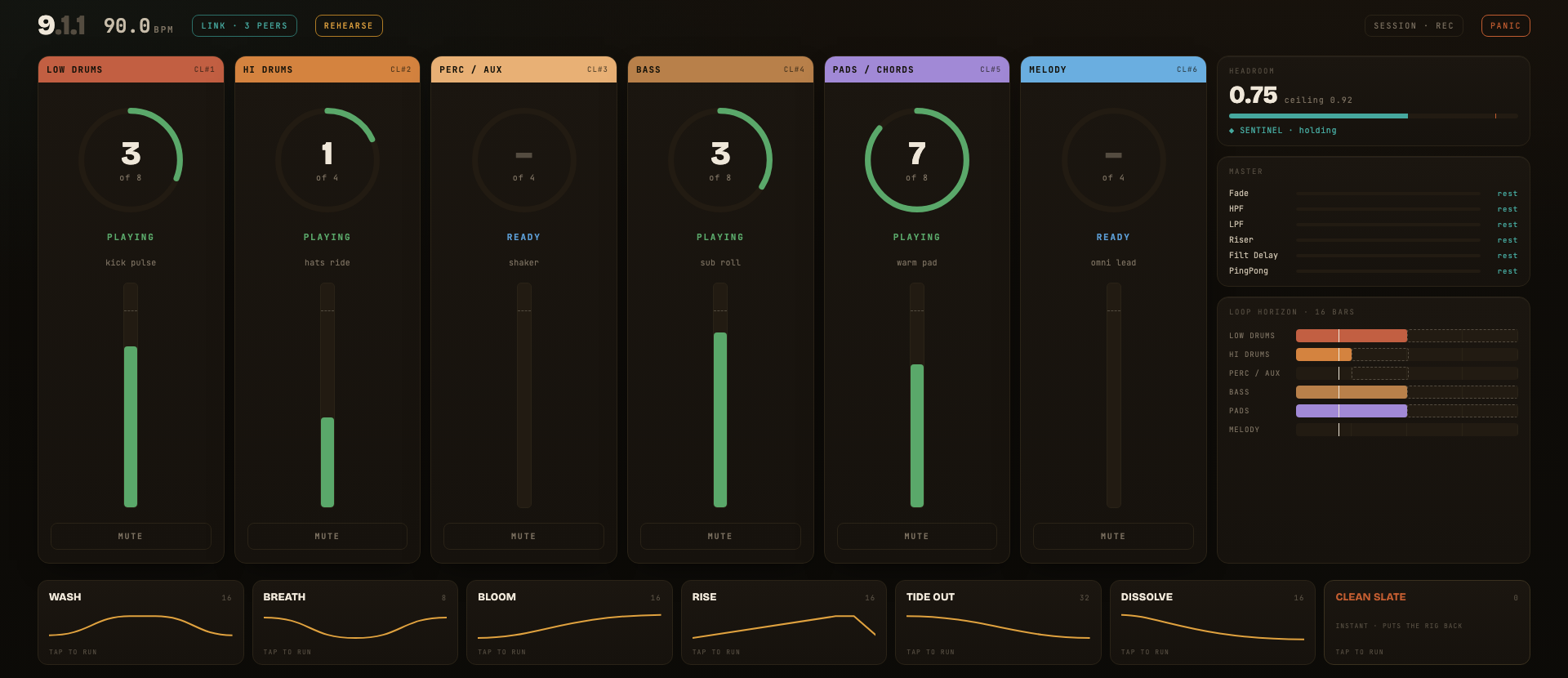
The flow.state console: six colored loop lanes with loop counts and meters, a headroom readout with the level governor holding, master effect macros, a loop horizon strip, and a row of macro moves named WASH, BREATH, BLOOM, RISE, TIDE OUT, DISSOLVE, and CLEAN SLATE, each drawn as its automation curve.

You came to play.

Every other looper asks you to run it. Configure it, watch it, ride it, all night, in front of people.
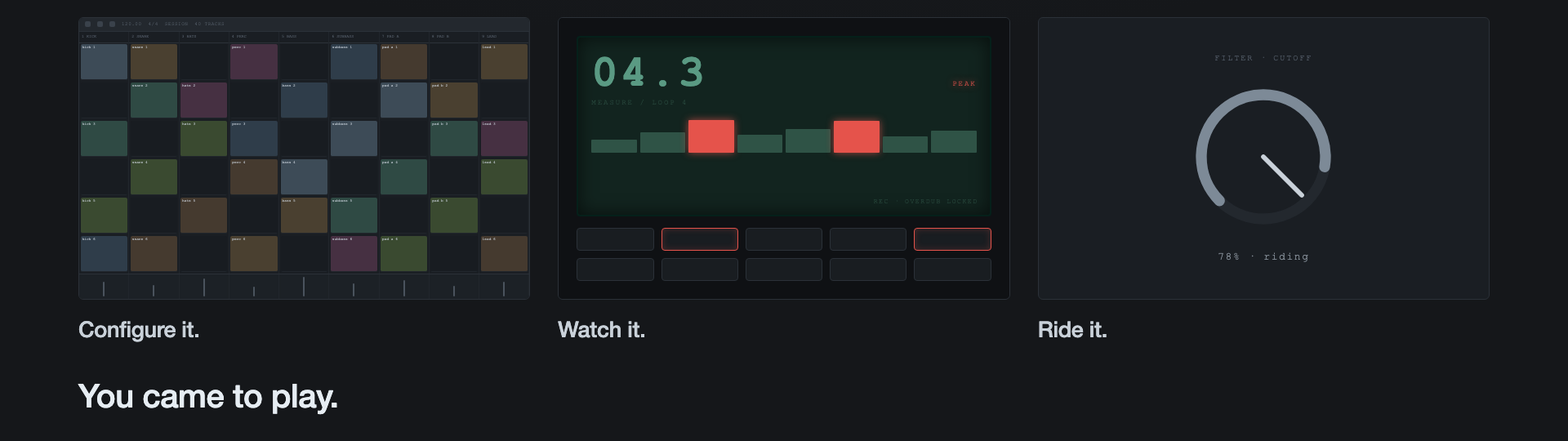
Three panels labelled Configure it, Watch it, Ride it, showing a session grid, a looper counting measures, and a filter cutoff knob being ridden at 78 percent.
Play it

Six lanes. They never move.

Every lane is a role with a permanent home. Low drums, hi drums, perc, bass, pads, melody. Your hands find the loop without looking, because it is always where it was last night.

Feet loop, hands play.
A foot controller drives record, overdub, and undo per lane, so both hands stay on the instrument.
The whole horizon.
One strip shows what every lane is playing and how much of it is left to run.
Audio and MIDI lanes.
Loop a phrase of notes that drives a hosted synth, the same way you loop audio.
Shape it

One tap. Sixteen bars.

A macro move rides whole banks of controls across the grid. The sixteen bar wash that used to take three hands now lands on the bar by itself. Touch anything it is riding and that control is yours again, instantly.
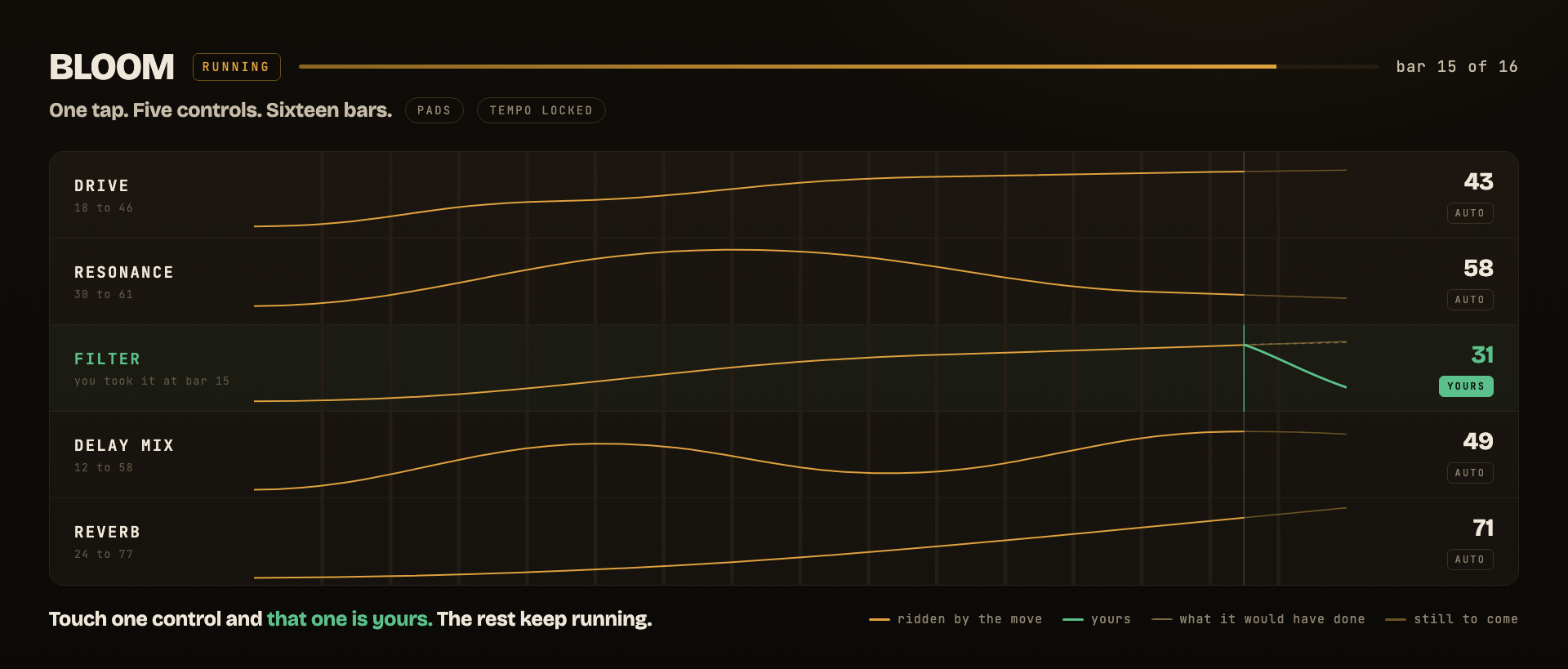
A macro move named BLOOM running at bar 15 of 16, with five controls plotted as separate automation curves across the same sixteen bars: drive, resonance, filter, delay mix, and reverb. Four read AUTO. The filter lane is green and reads YOURS, its curve diverging from a dashed ghost of what the move would have done, because the performer just took that control by hand.
Levels ride themselves.
A gain governor trims whichever bus is crowding the stack before it clips, then hands the level back. Stacked loops stay clear all night.
Chains locked to the clock.
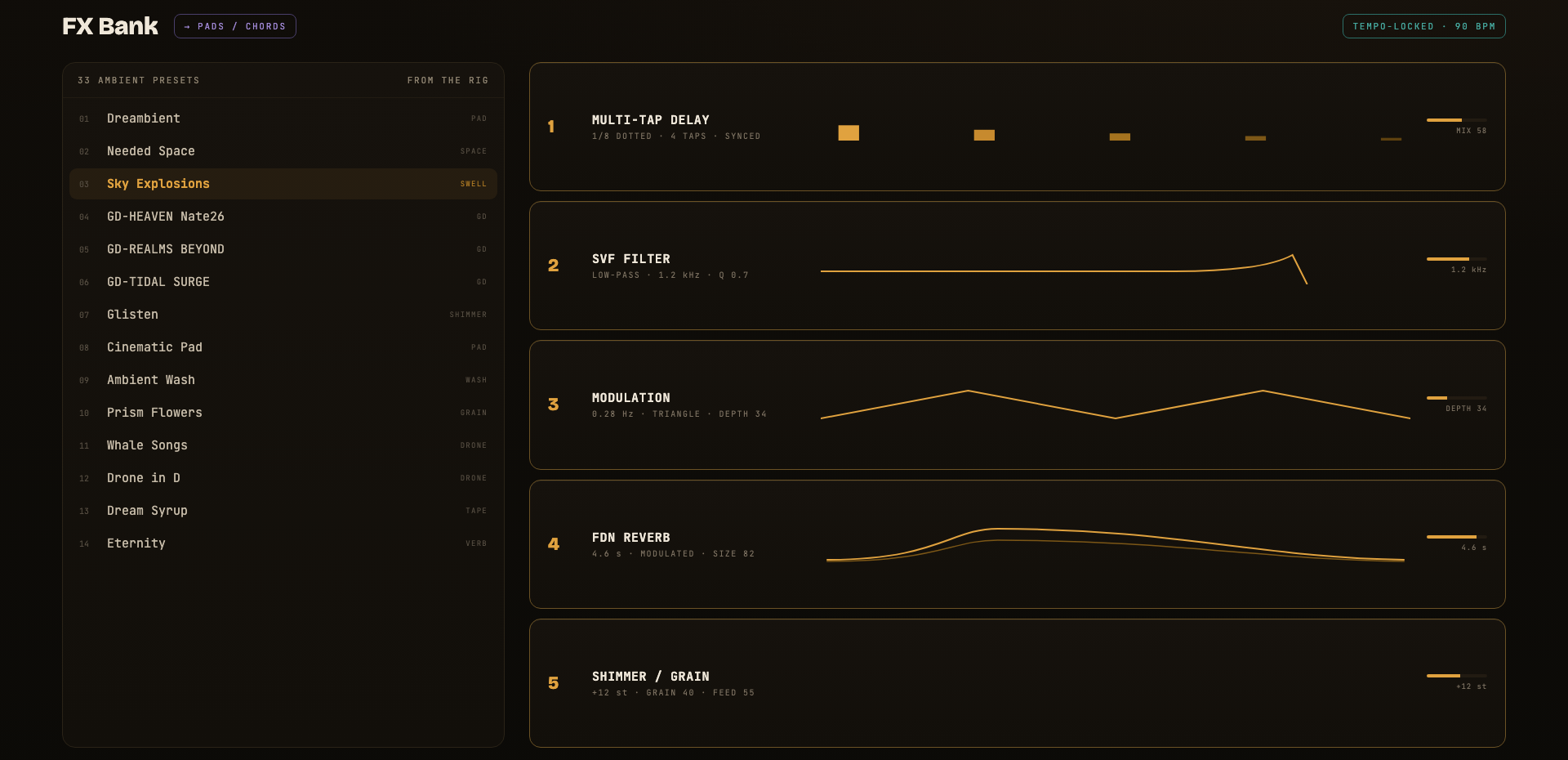
Delay, filter, modulation, reverb, and shimmer built in and tempo locked. One tap loads a whole chain.
Your plugins, hosted.
Audio Units run as inserts on any lane or the master, out of process, so one bad plugin cannot take the set down.
The FX Bank screen: a list of 33 ambient presets on the left with one selected, and its five tempo-locked engines on the right, a multi-tap delay, a state variable filter, modulation, an FDN reverb, and a shimmer grain stage, each drawn as its response curve.
Plan it

The night has a shape.

Build the set as sections, each with a key, a tempo, a feel, and the moves you mean to run. See the energy of the whole night before you play a note.
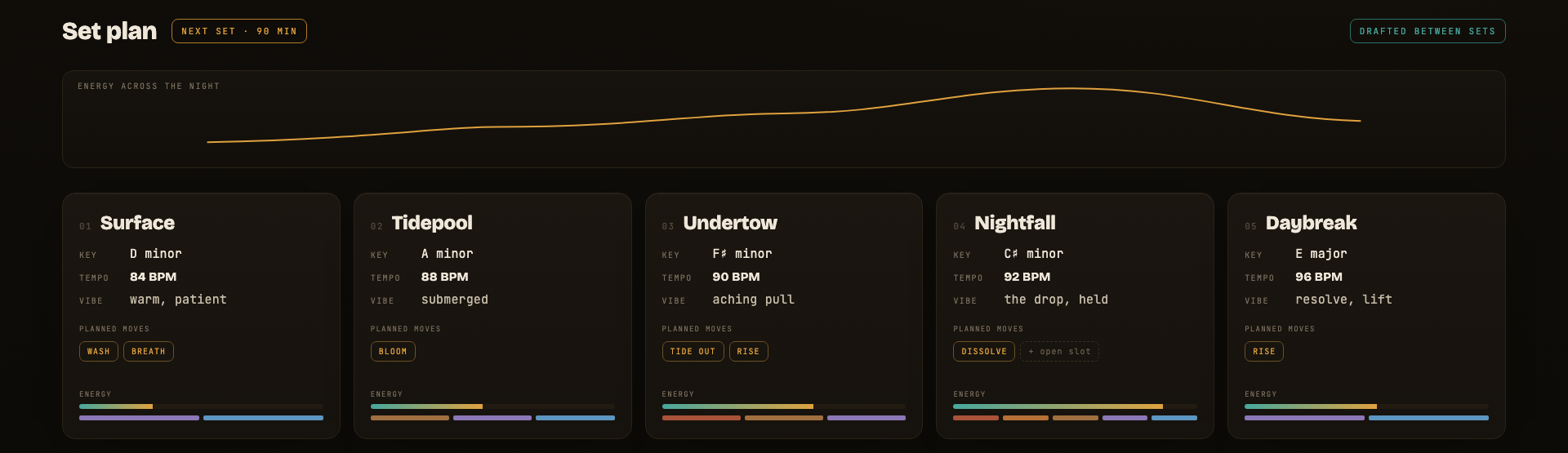
A set plan for a 90 minute set: an energy curve across the night above five section cards named Surface, Tidepool, Undertow, Nightfall, and Daybreak, each listing a key, a tempo, a one-word feel, and its planned moves.
A library, not a song list.
Clips live by key and type instead of one scene per song, so a single library plays a morning beach set and a midnight one.
Sets you can name and recall.
Save a working rig and bring it back exactly. Lanes, chains, moves, and controller mappings included.
Every show writes itself down.
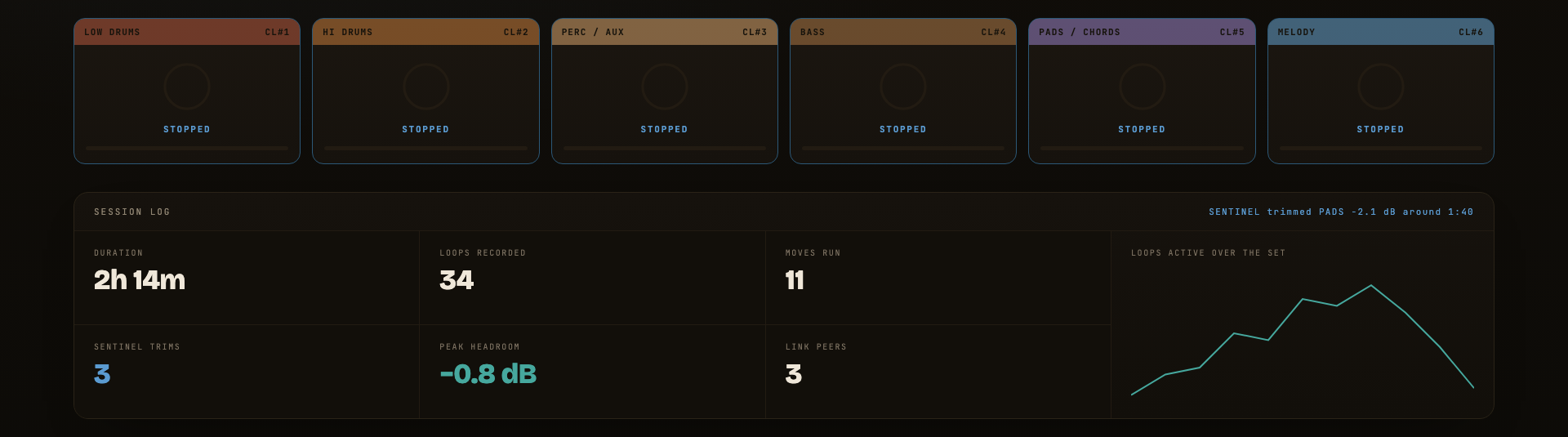
How long you played, what you looped, and every level the governor caught before the room ever did.
A finished set: six stopped lanes above a session log showing 2 hours 14 minutes, 34 loops recorded, 11 moves run, 3 level trims, peak headroom of minus 0.8 dB, and a graph of loops active across the set.
The payoff

Between sets, it does the homework.

It read the log your set just wrote. Now it has drafted the move you would have built yourself. It tells you which of your own moments taught it that, and waits for you to say yes.
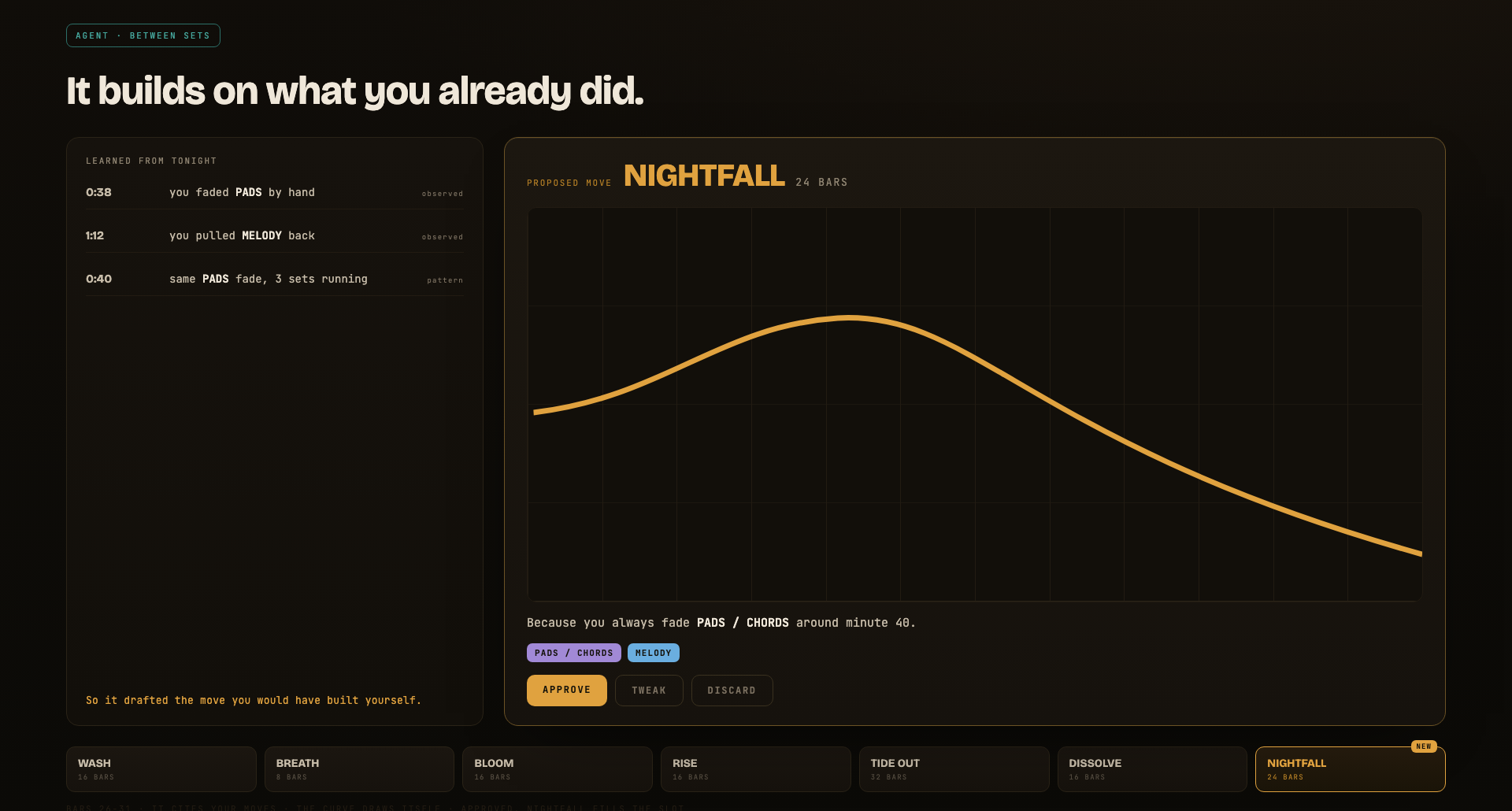
A proposal screen: a panel of moments observed during the set on the left, and a proposed 24-bar move named NIGHTFALL on the right with its automation curve, a plain-language reason, and approve, tweak, and discard buttons.
How it works

It learns from you, not from somebody else.

There is no model of what ambient music should sound like in here. The only thing it studies is what you already do, so what it hands back sounds like you on a better night.

Every night teaches the next one. 1You play. 2It writes it down. 3It spots a habit. 4It drafts a move. 5You approve it.
1You play your set the way you always have. Nothing is listening to the room, and nothing is making sound but you.
2The set writes itself down as it goes. Loops, moves, levels, and the exact minute your hands did each thing.
3Later, it reads that back and finds what keeps happening. You always pull the melody at the same point. You always fade the pads around minute forty.
4It drafts one new move out of that habit and shows you the curve, with the moments from your own set that taught it.
5You approve it, bend it, or bin it. What you keep is in your hands the next night, so the set you know gets deeper instead of longer.
↻ And then you play again, with one more move in reach that already sounds like you.
There is also less to learn here than you would expect. Six lanes, a row of moves, and a set plan. That is the whole instrument.

Live, nothing touches sound but you.

Hands always win.
Touch a control and the software yields instantly, mid gesture, whatever it was doing.
The room keeps its clock.
Tempo, transport, and scenes belong to the stage. flow.state has no way to write them.
Drafts stay drafts.
An agent can read your sets and write proposals. None of it reaches the stage until you approve it.
Native macOS Six loop lanes Audio and MIDI Hosts Audio Units Ableton Link MCP built in In build

In build, and further along than a demo.

The engine, the Mac app, plugin hosting, and the agent layer are written and under continuous integration. It is not released, and there is no download yet.

BuiltClock, loop lanes, macro moves, the level governor, MIDI lanes, effect graph
BuiltSet library, decks, and the clip wall
BuiltMac app and Audio Unit hosting, both passed on real hardware
BuiltSession logs, the validating compiler, and the agent proposal flow
BuiltTablet surface over the local network, running against a real rig
BuiltThe hardware rig, verified on the full gate suite. See what is on the table →
NowThe full native interface
NextFinal polish, then the full DSP effects rig

If you build for looping musicians, I would like to hear from you.

nathan.levin@gmail.com